

Assisi: art, spirituality, and nature in the heart of Umbria
You see it from afar, resting on the side of Mount Subasio like a vision that has found its shape. The stone takes on the pink of morning and the gold of sunset, changes mood with the sky, and breathes softly. As you climb toward the ancient walls, the world of the valley falls away, the noise grows gentler, and voices lower almost without noticing. Assisi welcomes you this way, with an invitation to measure, to slowness, to a step that listens.
Once through one of the gates, the city tightens and embraces. Lanes climb in steps, slip beneath arches, then open suddenly into squares scented with bread and incense. The houses have wrought iron windowsills and geraniums pointing red toward the light. From the workshops comes the smell of wood, leather, and fresh paper for hand bound notebooks. There is music in the background, sometimes a flute, sometimes a distant choir. In Assisi beauty often has its own soundtrack.
The first whirl is Piazza del Comune, bright and regular, with the profile of the old temple as a stage set. The stone columns are cold beneath your fingers, a caress and millennia shrink to the span of a hand. Around you stand dignified palaces, a café that spills chairs onto the square, the lively hum of groups that arrive and disperse. You sit for a moment, let your gaze find its measure, then your steps begin again. There is a force drawing westward, a magnet known even to those who claim not to believe, the Basilica.
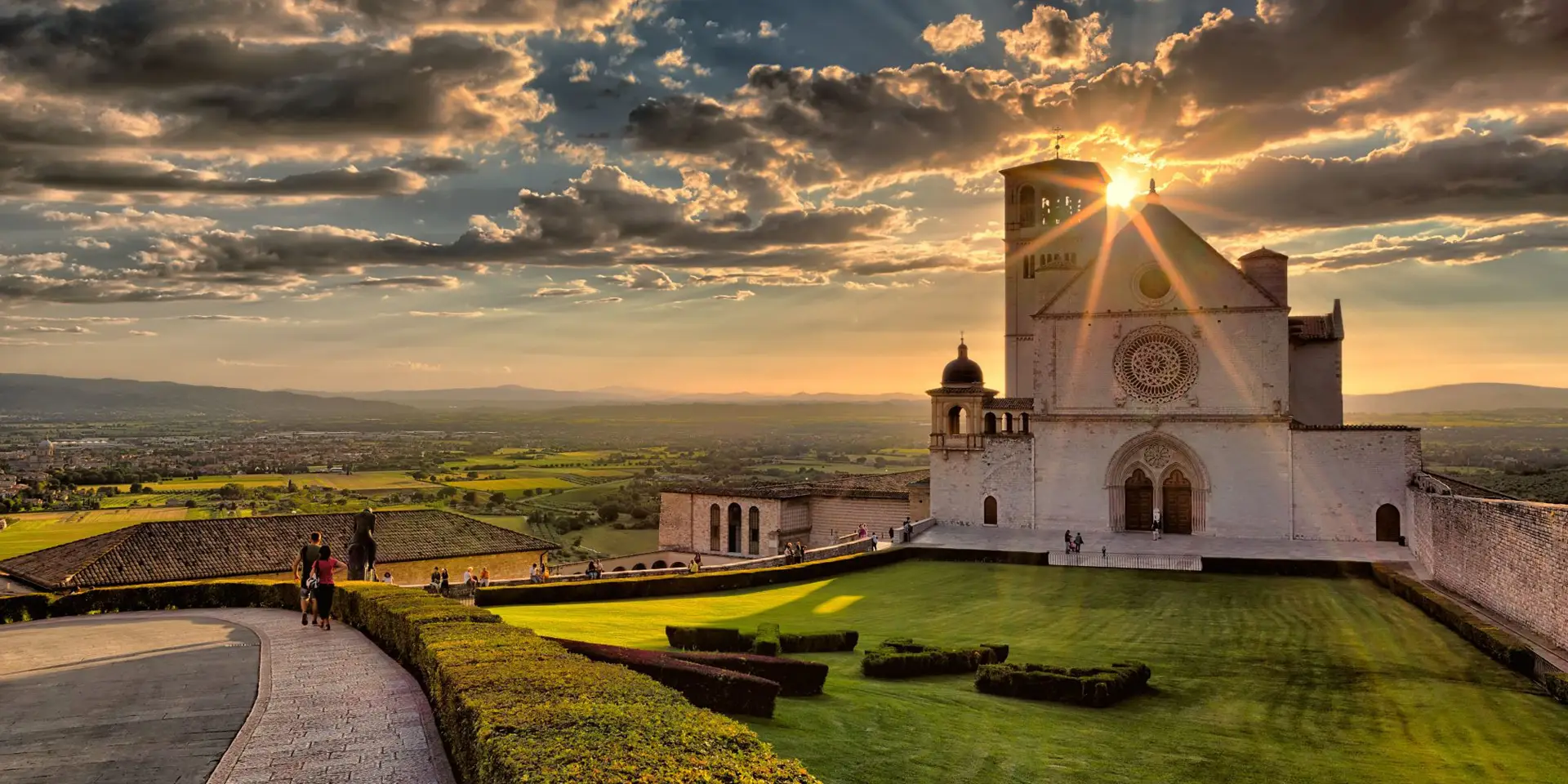
The street grows steadier and the stones underfoot sound different. The Basilica of Saint Francis is not conquered, it appears. First the white facade held taut like a curtain, then the staircase that imposes a fitting rhythm on the body, and finally the terrace that sets you before the horizon with a broad gesture. The air here has a particular scent of ancient stone and warm wax. You enter and the half light folds around you like a cloak. In the lower church the colors whisper, the naves are low, and your voice grows small because everything invites you to gather yourself. You walk slowly along the walls and the stories come to meet you, faces that seem to recognize you, hands that point, bare feet that advance. Descending toward the tomb, your pace slows on its own. You do not need to know the details to understand that for centuries people have come here to lay down weight and draw breath. In the upper church the light rises and the colors open. The narrative cycles move almost like cinema, as if the figures stepped off the wall to accompany you to the door. It is not a visit, it is a passage.
Outside, the terrace unveils a panorama that stitches hills and fields into a patchwork. Swallows draw black arrows in the sky and bell towers bring order to the horizon. The city begins again just beyond the terrace, yet after the Basilica you walk differently. Your step carries longer memory and argues less with the ground.
Assisi has a sacred geography that is also a walking geography. Beyond the walls along a road that leaves the mountain’s flank stands the Hermitage of the Carceri. The path climbs through a wood of holm oaks, the air smells of damp leaf and good earth, and the silence is never complete. Birds keep it alive, and the wind, and your own thoughts. The hermitage does not impose itself. It allows you to find it piece by piece, caves and small cells, stones pressed together like hands. Here the idea of retreat stops being an abstract word and becomes a physical act, to sit, to breathe, to listen. You understand that emptiness can be full and that simplicity can weigh as much as an altar.
Descending on the other side of the walls along a line of olive trees you reach San Damiano. The church is low and almost shy, the cloister a square of peace. The wood of the choir is dark, polished by centuries of hands, and the echo is gentle, as if sounds chose not to wound each other. Nearby the countryside takes its space with ancient gestures, rows of vines, gardens, dry stone walls. It is a more domestic Assisi that looks at the valley the way you look at a spacious room, with the pleasure of knowing where things belong.
In the heart of the city just beyond the square stands the Basilica of Saint Clare, holding a different light steady. Inside, your gaze lifts by instinct, and a crucifix that has heard many words explains better than any speech what a bond is when it remains faithful to itself. Outside, the porticoes stretch their shade and the steps fill with seated people. Someone reads, someone sketches, someone keeps quiet. The pink stone changes with the minutes. It is a slow theater where the protagonist is the light.
Down on the plain the Basilica of Saint Mary of the Angels guards the Porziuncola like a heart. Arriving from the upper city is like descending to a spring. The great sanctuary opens and inside, at its center, stands a small house of humble stone. The space around it is pure respect, a large room built to remember that the center of the world sometimes lies in a hut. When you step outside the plain widens and the cliff of Assisi becomes a high frame again, a nest you have just left.
Then there are days when the city changes its voice. At the beginning of May the air carries drums and songs, Calendimaggio, and Assisi divides and recomposes, Upper Side and Lower Side challenging each other with choirs, set pieces, flag throwers, and reenactments. Nights glow with fires and squares with vibration. It is not a festival for visitors. It is a festival of a community that finds itself in the serious play of memory. In summer when heat settles in, the city prepares another scene. The feast of Saint Rufinus and the ancient crossbow contest bring back a Middle Ages that is not only costume but discipline, concentration, measured gesture. In October when the air grows thinner and autumn lays copper on the leaves comes the feast of Saint Francis. The city fills with slow steps, with standards, with voices that carry oil for the lamp. No one raises their voice. People walk arm in arm. It is a rite that explains belonging better than any flag.
Assisi is not only churches. It is also a watching fortress, the Rocca Maggiore, with its ramparts and a wind that cuts straight. Climbing up there means measuring the city with your eyes. The houses are a mosaic in which you recognize the tiles you have just crossed. The valley is a carpet unrolling without dust and the mountains form a border. Mount Subasio, rounded and capable of great silences, takes over the sky. Its pink stone returns to vibrate in your memory and you realize the city is the explicit daughter of that mountain.
If you let your feet choose for you, you often find yourself in the eastern woods, a green corridor descending toward the stream. It is a gentle passage between olive trees and low walls, cicadas in the high hours, songs of water when the season is generous. The path slides, cuts clearings, slips beneath forgotten stone arches. It is a side of Assisi off stage where the sacred lies in the way light rests on a leaf, in the composure of a carved stair, in choosing not to leave useless traces as you pass.
Food here is not a pause. It is part of the story. The oil from the olive trees of Subasio has a clear grassy perfume that seems to speak the same language as the stone. Bread warmed on the griddle asks only for that. Rough strangozzi hold sauce with a loyalty that moves you. When truffle arrives its scent fills rooms like good news. Norcia style cured meats do the rest, salumi, cheeses, a board that is an edible map. In certain shops simple sweets of almonds and honey appear, distant cousins of ancient recipes. The wine may come from a nearby hill, but here it finds the right glass. At the table you confirm what the streets suggested. The essential is not poor, it is exact.
There are hours when Assisi entrusts you with small secrets. At dawn the stone is cold and smells of night, footsteps ring louder, and shop shutters are lowered like eyelids. At noon the shade narrows and alleys turn into pale blades. Doorways warmed by the sun give off the scent of wood. Late in the afternoon the bell towers light up one after another and for an instant the city is a score, chimes calling and answering. In the evening when lights grow few and soft, a breath of wind moves between the stones and the city seems to enjoy standing guard over the dreams of those who remain.
Assisi is also a passage, not only a destination. Long routes take it as a hinge, ways that descend from the north toward Rome and stop here for a night or two. You recognize the walkers. They have dust on their shoes and eyes that count less than before and see more. They meet the city with gratitude, cross it without asking too much, and sit on a step to watch the swallows cut the sky. It is an ancient gesture that the city knows and recognizes, welcoming without noise.
When the sun turns and Subasio sets its back to you, Assisi changes color. Walls receive a deeper pink and shadows pour into courtyards like slow water. Even the silence changes tone, no longer the invitation of morning but the gathering of evening. A window closes, a dog barks in the valley, a last group descends from the terrace like a comet of chatter that fades quickly. Stone returns to stone, the light stops working miracles, and what remains is the perfect measure the place built through centuries of hands and gazes.
Before you go it is worth returning for a moment to the western terrace. The wind carries scents of hay and wood and the valley prepares for night. You hear a choir in rehearsal, a phrase repeated until it becomes a prayer even for those who do not pray. The basilica behind you breathes and the square before you grows calm. It is a balanced instant, a photograph that asks for no filter. You understand without saying it why so many people return here, not to tick off a list but to set their own pace in order.
The descent toward the plain is a return to gravity. The cliff remains behind, the basilica tilts and vanishes, the fields take up their patterns again. The journey continues with a scent of wax and stone, with a memory that needs no souvenir to endure. Assisi does this. It does not fill you, it brings you into focus. It leaves a lasting pink in your eyes, a longing for simplicity in your hands, and a right rhythm in your breath. Later, elsewhere, when you hear a bell strike in any city, a piece of this hillside will light up inside you like a small lamp that remembers the true center of things.


