

Clitunno Springs: where water remembers
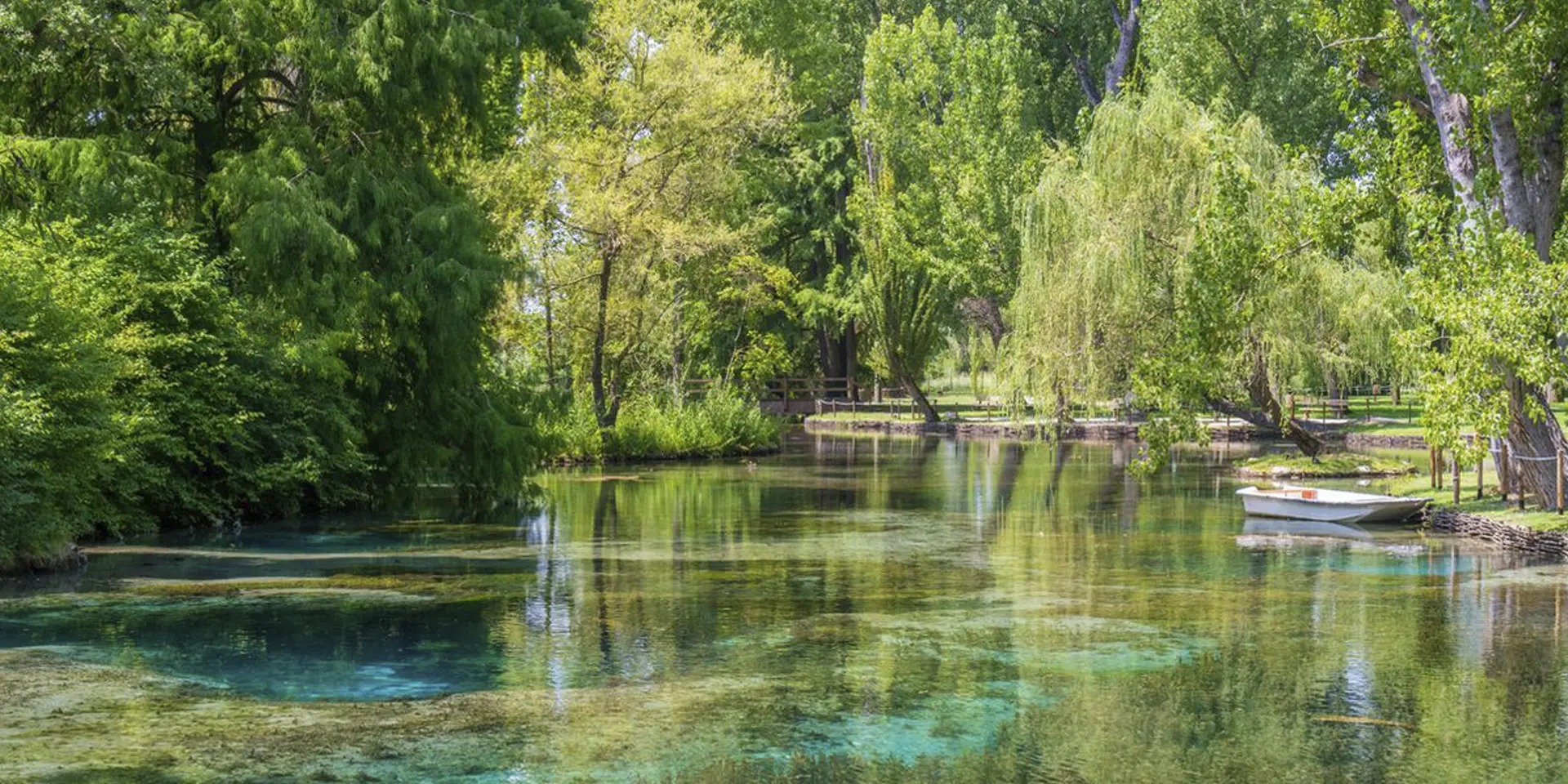
You arrive along a road of olives and vines, a soft line between Trevi and Spoleto that smells of good earth and light wind. At a certain point the plain turns to whisper, the foliage tightens, the air changes scent. From the depths comes a coolness of stone and wet grass, an ancient perfume like a word learned in childhood. The Clitunno Springs do not arrive with a flourish. They arrive slowly, like something that has always been here. First a murmur, then a glimmer between the branches, and finally the water shows itself, a natural basin of emerald and glass, threads of grass waving gently on the bottom, perfect circles around a leaf fallen from a poplar.
You draw near almost on tiptoe. The surface reflects everything, the sky, the crowns of trees, a passing cloud, the face of the one who looks. Each step along the bank changes the image as if someone had tilted the mirror a little. The water is so clear you are tempted to count the tiny springs one by one. You see the sands stirring from below like a breath. Here water does not run, it is born. It does so in silence, stubborn and precise. Then it gathers into a round pool, rests for a moment, and finally sets off. This is the beginning of the Clitunno, the river that gave its name to everything.
Around it the park is a stage that does not pretend. Poplars lift pale trunks and light leaves, willows touch the water with green fingers, footpaths thread between patches of shade and openings of light. There are wooden benches worn by the seasons, a creaking fence, a little bridge that invites you to change banks just to watch the color shift. At times the sun slants down and lights the bottom. The green deepens and you understand that here you need only bend down to find a whole landscape in a handful of centimeters, tiny bubbles, pulsing sand, vegetal filaments bending like hair under water.
The Springs have a long memory. Before this was a tended park it was a sacred place, a venerated source. The ancients came seeking omens and answers, ablutions and rites. No sign is needed to tell you so. The measure of the silence says it. Later other pilgrims came, this time with pens in their pockets. Poets, travelers, and writers tried to find words for what you gather easily today, the grace of clarity. They saw bulls whitened for ceremonies, reflections that look like thoughts, the long shadow of classicism that here is not shown in marble but in water.
There is a simple gesture everyone makes sooner or later, to sit. On the wood of a bench, on a stone edge, on an extended root. You settle by the water and let the sound put things in order. Up close the noise is a weave, a fuller eddy, a fine thread, a small overflow that strikes always the same. Close your eyes and you can separate the layers as if they were instruments in an orchestra that knows how to play softly. Open them again and the water is there once more, the same and new, and inevitably you find yourself smiling for no particular reason.
The seasons change almost nothing and change everything. In spring the crowns are new silk, greens multiply, the water seems livelier. In summer the noonday sun smooths the light and evening draws out long shadows that the water receives like honored guests. In autumn the yellow of poplars and the copper of willows melt into the lake and the surface becomes a quiet palette. In winter the mist holds banks and sky together, your breath is visible, and the silence has a deeper, coatlike quality. There is never spectacle. There is a gentle continuity that teaches you to remain.
A little further along the road a small piece of architecture awaits those who know how to look, the Clitunno Temple. It is not large or loud. It stands there like a severe miniature, with a pediment that recalls the ancient world and a Christian heart that turned the spring into a place of prayer. Pale stone catches raking light, the columns mark a brief rhythm, and inside paintings survive that time has only softened. On those walls you see a double gesture, a hand recovering and a hand reinventing. It is a beauty that does not overwhelm. It offers itself and, if you wish, you enter and stay a while, standing or seated, to do what best suits this place, to listen. The sound of the road barely reaches you. The water here as well feels like a presence that speaks without a voice.
Returning to the Springs your step has already changed. You no longer search for the best spot. You let the water and the light choose for you. You may spend long minutes following the journey of a leaf. It drifts toward a source, spins on itself, moves away, stalls against a blade of grass, and starts again. A duck draws a thin wake, a moorhen writes a brief arc and vanishes under the bank. In one corner where the sun does not reach the water seems bluer. A few meters away where a shaft breaks through it is glass.
Look closely and the banks tell of work. Aligned stones, a railing, a path kept up. Someone, every day, keeps simple what could become complicated. Beauty here is not an accident. It is an agreement between nature and care. You see it in small details, a plank fixed in the right place, a branch pruned so it will not cover the eye of the spring, a bin emptied when no one is watching. It is a way of saying thank you to the place itself, allowing water to remain water and quiet to remain quiet.
When it is time to leave there is no real farewell. The Springs stay behind almost unnoticed. Once the road lies again between you and the water the wet scent yields to olive, the light grows harder, a tractor sounds in the distance. Yet the clear pool remains behind your eyelids like a liquid photograph. You realize you are taking away less an image than a rhythm, a slower way of seeing, a new patience, a small reserve of silence.
Later, elsewhere, a singing tap in a sink or a puddle that holds the sky for a minute will be enough to bring back that smile. The Clitunno Springs work like this, they do not amaze with shocks but speak in a low voice like a well spoken formula. They remind you that water remembers, that clarity requires care, that the sacred can hide in a reflection, and that sometimes, to truly hear, it is enough to sit and let a little river pass through you.


