

Spello: history, art, and an explosion of color in the heart of Umbria
Spello reaches you before you reach it. From the valley floor you see it settled on the flank of Mount Subasio like a patch of honey and antique rose, a constellation of houses stitched together by lanes as fine as filigree. The road climbs slowly through olive trees as old as oft told stories, the air grows brighter, and the silvery green of the trees takes on an almost liquid consistency. It is one of those places where time decides to get comfortable. It does not run, it flows, and you fall into step without even noticing.
Once through the gate, the village holds you with firm gentleness. The stones have a precise temperature, warm in spring, hot in summer, cool in winter, and your soles beat a crisp rhythm on the paving. In Spello there are no long straight lines. Every street hints at a curve, every curve prepares an arch, and behind an arch there is always a surprise. You look up and find yourself beneath Porta Consolare, which the town wears like a medal pinned to its chest, with statues keeping watch, still and ancient and tempered, over those who enter and those who leave. A few steps away the Towers of Propertius show that severe Roman elegance which here has never stopped speaking with the Middle Ages, like old friends at the same table.
Spello should be walked without hurry. The alleys are a collection of small stage sets, stone arches framing the sky, balconies leaning out like questions, doors that tell of life beyond the wood. The windows keep an obstinate show of flowers that knows no season. In spring they sing in chorus, in summer they burst, in autumn they grow intimate, in winter they endure with tenacious geraniums and waxy leaves. It is not display, it is a mother tongue. In Spello flowers do not merely decorate. They reason with the stone, soften it, contradict it, make it domestic. You may turn into any lane and catch the scent of water just given to the plants, that clean damp smell the earth returns like gratitude.
There is a point where the village changes rhythm and becomes a sanctuary of art. The church of Santa Maria Maggiore faces the square with restraint and does not reveal to those passing quickly that inside it hides a secret. Once you cross the threshold the air grows denser and your eye learns to proceed by degrees, the breath of the nave, footsteps setting their measure, a right darkness that prepares the light. Then the chapel opens like a music room and colors kindle with the disciplined grace of important things. The world outside disappears and you remain inside a story told by figures that seem to know your name. The painter, with the hint of a smile, scattered small jokes among the devotion, details that take you by the hand and say look closer. Beauty here does not shout, it speaks plainly.
Outside the church, the town takes up its pace again. The sun slides over the stones and changes angle with the hours. In the morning it slips through portals, at noon it spreads like a pale blanket, at sunset it turns to honey and sets the finest facades alight. Artisans work with doors ajar, a light incense of leather, a hammer’s tap, the rustle of paper in the little bindery where hands still seem to know the exact weight of each sheet. At the end of a lane you find a workshop displaying glazed pottery with patterns that seem to have risen from the earth itself, leaves, tendrils, small animals. Spello is in no rush to show you things to see. It prefers to let you feel inside a weave.
The kitchen is a conversation the town opens with whoever arrives. The oil from Spello’s olive groves has a clear, clean perfume, almost cutting at first and then long, and on warm bread it becomes a story at once. Bruschetta is not an appetizer, it is a secular sacrament. Strangozzi cling to sauces with the right roughness, wild greens carry to the table the scent of sun baked walls, and norcineria adds its generous Latin, cured meats and sausages and a pecorino that marries dark honey. If you like, ask for a glass of Trebbiano Spoletino that falls into the glass a pale color with a hint of wet stone, or a hill red that speaks of cherry and poise. You do not need an encyclopedic menu. You need the sure hand of those who know what grew yesterday two fields away.
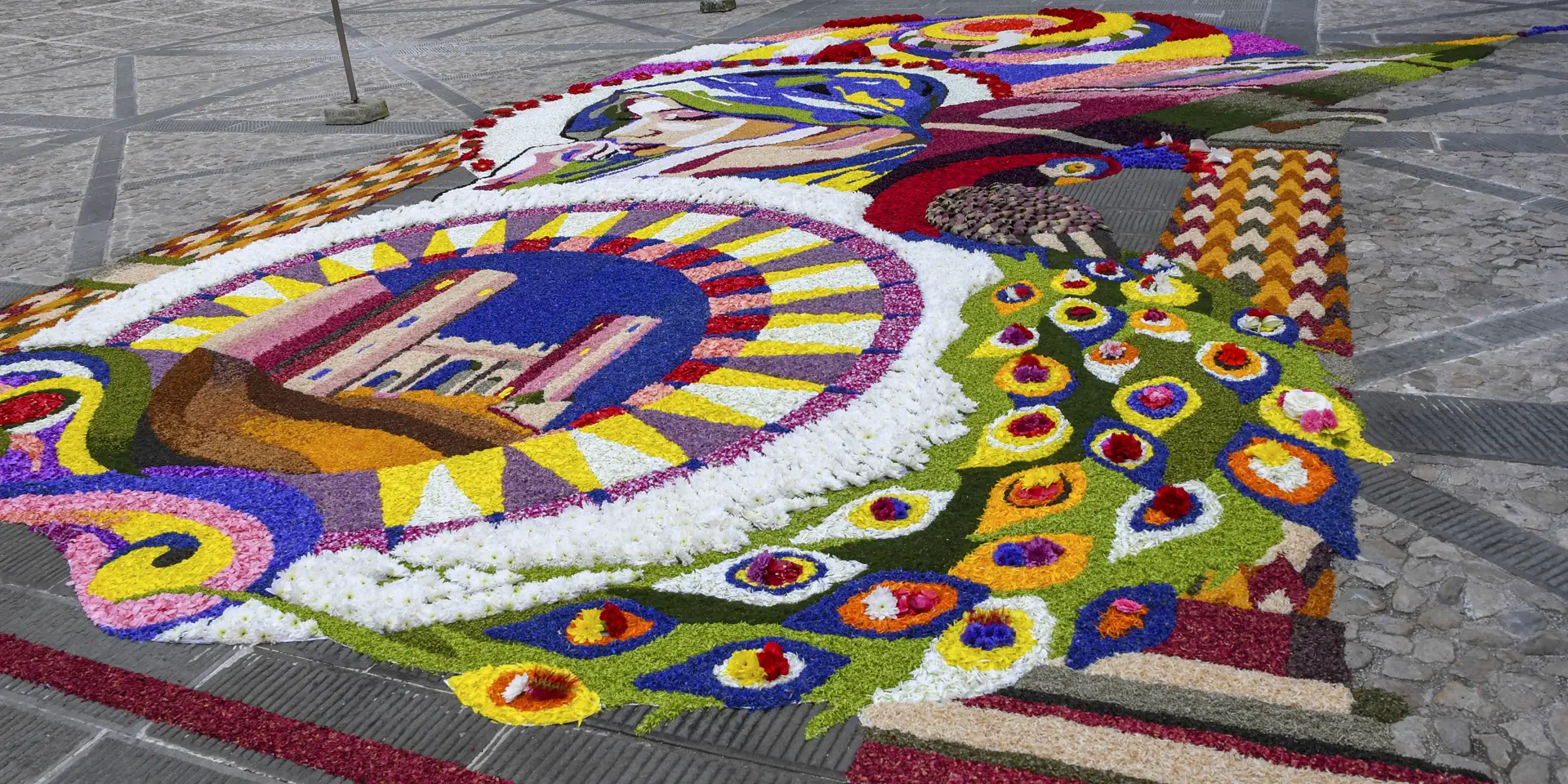
Spello has one day each year when it dresses in its truest garment. As Corpus Domini approaches, the entire town becomes an open air workshop. Streets turn into tables, courtyards into studios, storerooms into rooms of perfume where yellows and reds, greens and blues are mixed in a fragile and powerful grammar, petals, leaves, herbs, whole flowers. The night before is a collective breath, big hands and small hands working together, someone drawing, someone cutting, someone composing. At dawn the town opens its eyes and the streets are no longer streets. They are carpets of color, minute designs, geometry, symbols, figures. Walking without treading on them is an exercise in delicacy. Standing aside to watch the procession slip over those tapestries of petals is to understand what a community is when it decides to remember something together. Later the wind does what it must, it carries the colors away gently and returns the stone to its ordinary pace. That is the loveliest part, knowing that beauty, to be strong, does not need to last.
Around the village the countryside opens like a book without noise. The olives of Subasio are not simply trees, they are columns of a temple you may enter without a ticket. Their leaves hold a different light, silky, and when the wind turns them you see the back of a fish surface and vanish. At certain hours the cicadas’ hum is a continuous fabric and the white road throws a flash that makes your eyelids narrow. From below the view of the hill town explains its balance even better. It does not dominate, it lives. It does not press down, it welcomes.
Along the edges of town, walking at the right pace, you recognize the oldest words. A stretch of wall lingering on, the base of a Roman arch, a stone incised with marks that need no translation to say we have been here a long time. Spello carries the weight of its history with an ease that elsewhere often turns into pose. Not here. Here memory becomes use, like those worn steps that through being walked have become more comfortable. In one corner hides the trace of an amphitheater, elsewhere a mosaic has found a home in a museum that speaks clearly. You do not need everything at once. A single well placed clue is enough to show the way.
Everyday life on days without festivities is the best plan of all. Morning smells of bread and coffee, the clatter of small cups and a laugh slipping out of a bar in a low voice. At midday steps become seats, the line at the bakery moves quickly, someone comes in only to ask is the new oil ready. In the afternoon shutters cast shade, light withdraws from the main streets and slides into the side lanes, shops stay open as needed, a grandmother chats with a neighbor about flowers, a cat crosses as if it had an appointment. Evening lamps trace a soft line along the walls, the air grows cooler, and the stone gives back the day’s stored warmth and turns it into a caress on the skin.
There are private moments Spello gives to those who choose to earn them. The dawn of a weekday when the town is all yours and Subasio lights slowly, a summer storm washing the streets and leaving the scent of crushed herbs and soil, a winter Sunday with a clear sky and keen air when the pink of the stone becomes almost solid honey. In each of these moments you understand that the worth of the place is not in a list of sights but in a capacity, to change your pace.
At dinner, the dishes are well mannered without giving up character. A soup of legumes that tastes of the hearth, a bunch of chicory sautéed with garlic and oil singing in the pan, a plate of strangozzi with seasonal mushrooms, a slice of torta al testo holding its fillings with dignity. Dessert arrives without fireworks, a biscuit scented with almond, a cream that remembers everyone’s childhood, a small amber glass that closes the conversation. There is no fashion, there is craft. There is no pose, there is substance.
Climb a little higher beyond the last row of houses and the path enters the woods and the air changes scent, leaf and resin and water running somewhere unseen. From one point the Umbrian Valley lies like a map, Foligno below, Trevi like a nest on a hill, Montefalco on its balcony. Spello stands among these presences like a sister who speaks softly and does not need to overstep. In such moments geography is no longer a list of names but a sense of belonging.
Even the smallest rites have their place, buying a bunch of flowers because you cannot leave Spello without a color in your hand, sliding a postcard into the slot of an old letterbox that still does its job, stepping into a side church just to give thanks, greeting a dog that guards a passage like a kind usher. Travel here stops being a checklist and becomes a conversation. Every word spoken well brings an answer back to you.
Spello asks for attention in return. It is not a place to cross with your mind elsewhere. It does not love noisy footsteps. It does not take kindly to haste. Its stones record every shade, they sense whether you truly look or are already thinking about the next stop. When you truly look, they grant small spells, a vase set exactly at the corner where the lane turns, a tower profile aligning perfectly with a cloud, a light curtain making the sunlight ripple like water.
At day’s end, seated on a step with Subasio at your back and the Umbrian Valley before you, you see that Spello’s measure is taken not in meters but in breaths. You count a few, slowly, stretch your legs, and think how some towns ask you to go fast while others teach you to stay. Spello belongs to the second family. It educates you to slowness without ever becoming lazy, offers beauty without making you feel like a spectator, sets you beside those who live here without turning daily life into spectacle.
When you leave, the road downhill feels new. The light filtering through the olives is different from when you came, perhaps because now that green holds a quota of memory. In the mirror Porta Venere shrinks to a sign, the town grows small, the pink of the stone mingles with the sky. Yet you carry it away simply, in hands that smell of oil, in eyes that have learned to read flowers like words, in a stride that at last has found its rhythm. Spello keeps flowering even when you do not see it. Close your eyes and replay the sound of your soles on that paving, two or three steps, a breath, an arch, and light again.


