

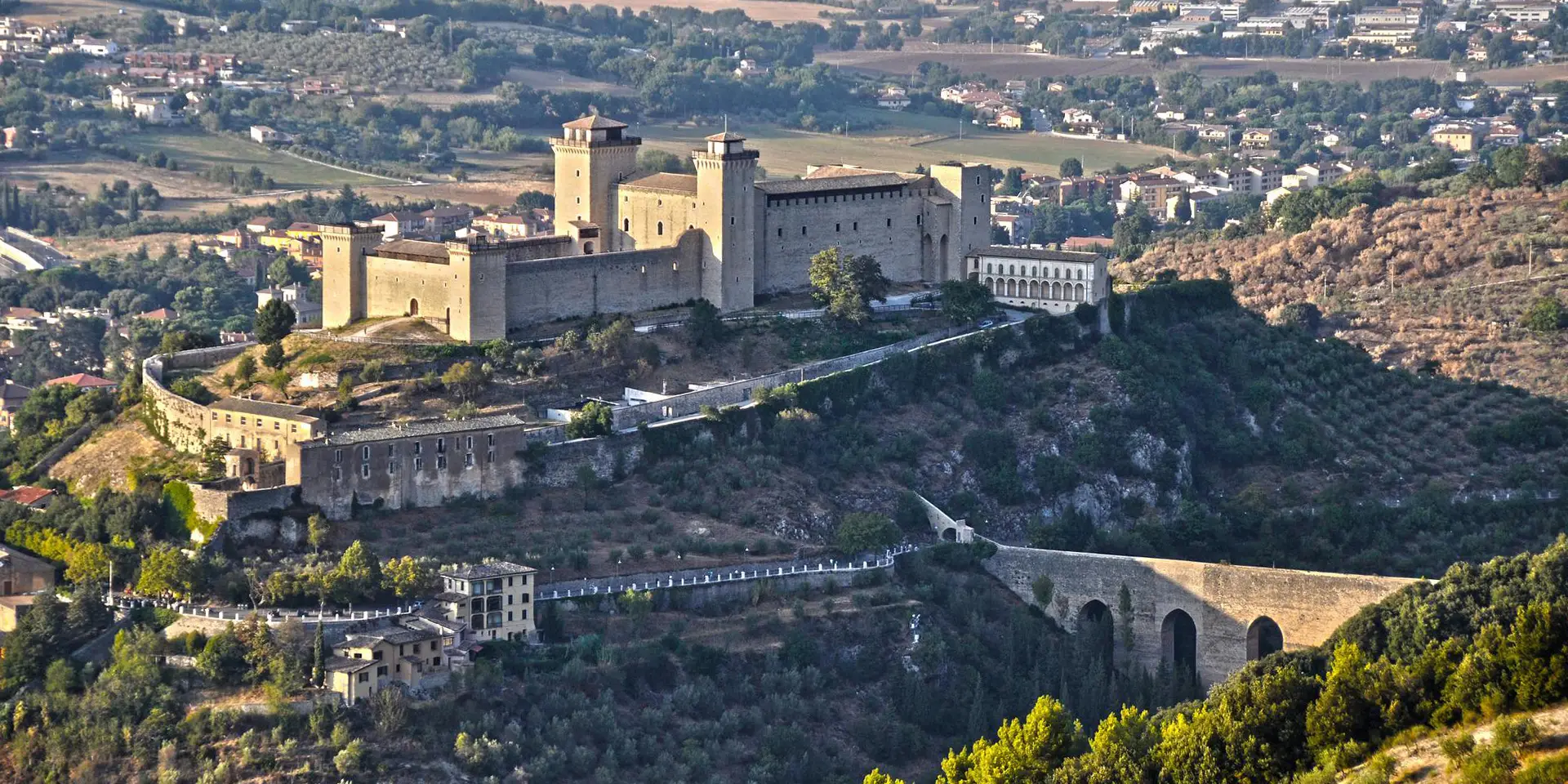
Spoleto: stone rising like a wave
You see it lift from the valley floor like a wave of stone. Spoleto climbs calmly up the hillside, bunching houses into clusters, turning into towers, arches, stairways, until it leans out from above with that fortress that looks like a seal stamped by the sky. Arriving means learning a different rhythm. The plain drops away from your soles and the streets begin to speak in climbs, then landings, then more steps again. Your breathing changes pace and, almost without noticing, you find yourself inside a city that asks for attention and offers poise in return.
The entrance is an invitation. Thick walls, gates that have watched centuries of armies, merchants, pilgrims go by. Spoleto is a grammar in which every word—stone, wood, wrought iron—has been repeated so often it feels perfectly natural. The streets do not run straight. They insinuate curves, prepare turns, gift you sudden openings. An arch frames a terrace, a medieval palazzo rests on a Roman base without flinching, a lane narrows until it becomes a whisper. When the sun finds the right angle the city lights up the color of toasted bread, and shadows pull out the secret drawing of jambs, eaves, friezes.
There is a point where Spoleto stops being only a beautiful maze and reveals itself as a natural theater, Piazza del Duomo. You reach it through a gorge of buildings and suddenly a breath opens, a fan. The square descends in steps toward the cathedral like a parterre, and the façade, pale and composed, holds center stage without arrogance. At certain hours the silence is such that you hear the swallows’ wingbeats like scissors in the air. At others the square becomes a living scene, and you understand why here a ritual was born and is renewed, a festival that blends music, dance, and words and has turned this open space into a sky lit stage. You do not need to remember who invented it or when. Sit on a step and look. The audience is the city itself, the ceiling the Umbrian evening, the curtain the façades slowly darkening.
Inside the Cathedral of Santa Maria Assunta the light changes register and becomes narrative. The marble underfoot has that good chill that sets thoughts straight. The frescoes hold devotion and craft together, and an altar gathers sighs that have crossed centuries. It is not a museum. It is a great room of a house where people still come to speak with those they cannot see. You stay a while, let your gaze sink, then return to the square and the day is two minutes shorter, but somehow better.
In Spoleto every direction is a promise. If you climb toward the Rocca Albornoziana, the path coils around the hill with stone curves and views keeping an eye on the valley. Above, the air changes scent, hillside grass, bark, a breath that has touched the walls. The fortress has the severe grace of military things that have finished their job and now simply watch. From the ramparts your eye runs free, recognizing the weave of the city and, lower down, of the countryside. To the west


