

Montefalco: the terrace of Umbria where wine takes the stage
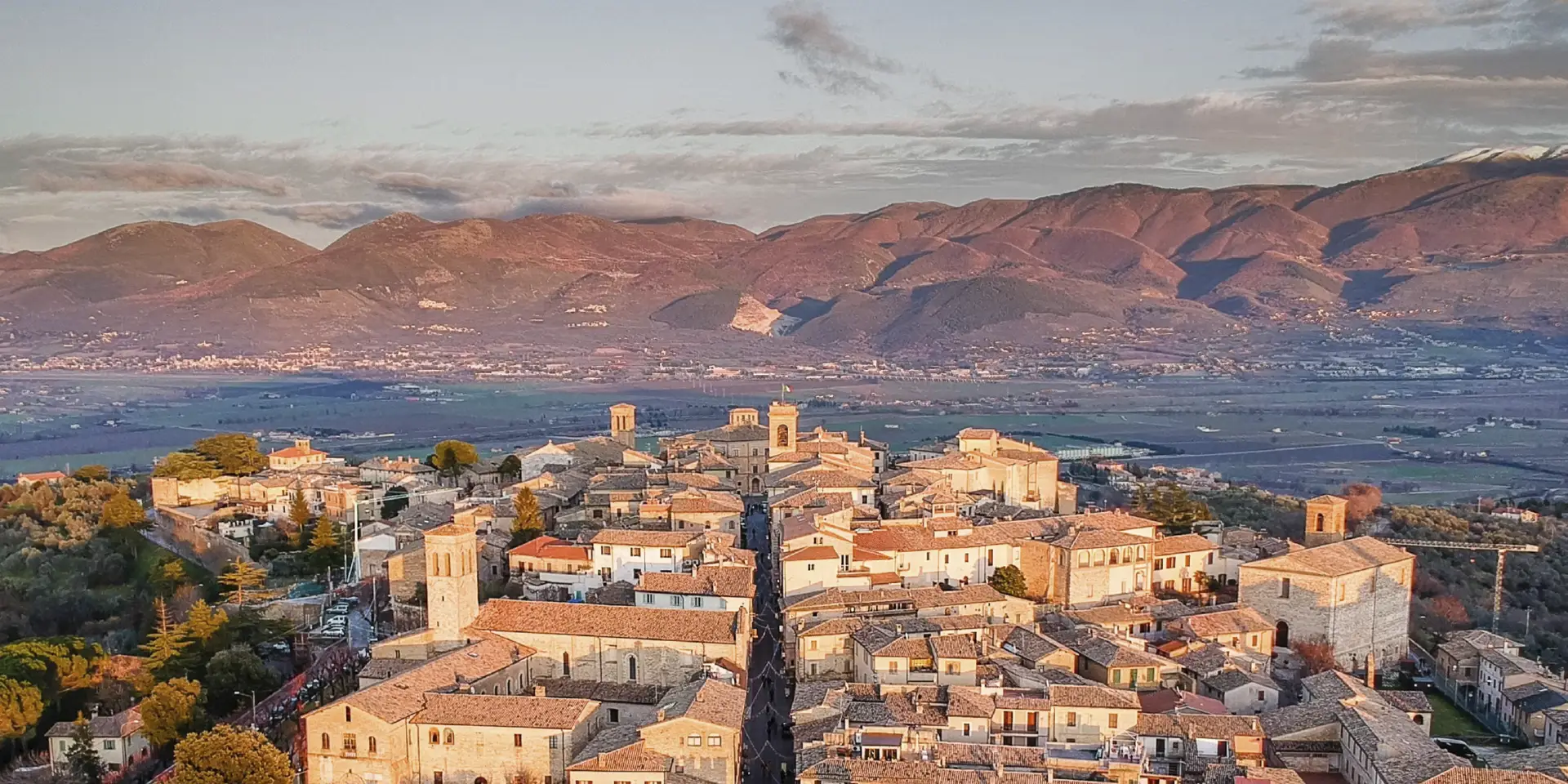
Montefalco meets you from afar, perched on a hill built to look and be looked at. The road climbs between neat rows of vines and ancient olive trees, the air changing scent at every curve — first sun warmed soil, then cut grass, then that unmistakable breath of a cellar arriving like a promise. They call it the Balcony of Umbria, and the name is no exaggeration. When you pass through its gates and step onto the terraces, the valley opens in a living map all around you. To the north you spot pink Spello, to the east Foligno breathing in the plain, to the south Trevi climbing its slope, and further still the ridges toward Spoleto. Over all of it rises Mount Subasio, round and watchful like an old friend holding the landscape together.
Entering the village changes your rhythm. The stone glows warm like honey, turning to amber at certain hours. Alleys coil softly, houses brush against each other, doors carry hand forged iron you cannot resist touching. The main square is an open room, with the Town Hall as a history book and the loggia giving shade at noon. Sit a while on the steps, let your eyes wander, then stand and follow your feet — in Montefalco walking is the natural way to understand.
There is a place where voices lower on their own: the Complex of San Francesco. Crossing the threshold, light changes tone and the centuries line up before you. Inside the church museum, the stories painted on the walls are not distant frames but presences that draw near, human gestures still speaking, colors that have learned to live with time. It is beauty that builds memory quietly. You leave feeling as though you were given a story you will not forget. Nearby another voice calls gently — Saint Clare of Montefalco, the nun who became the symbol of a faith rooted in work and silence. In the convent that bears her name, among measured cloisters and calm rooms, you understand that sanctity here walks at the pace of those who labor and keep still.
Outside, the town resumes its daily rhythm. Montefalco lives in the double heartbeat of village and field, and when you look through any gate the horizon is a mosaic of vines. Sagrantino here is not just wine, it is landscape. You see it in the tight rows, in the slopes’ curves, in the hands that move at harvest among clusters dark as jewels. In autumn the hill changes skin. The air smells of must, tractors draw slow patterns, cellars glow late into the night, and from the streets drifts that blend of yeast, wood, plum, and spice. During harvest days Montefalco hums with old gestures — buckets, shears, laughter, bent backs, and later the long glass shared at a doorway.
In the cellar Sagrantino teaches patience. In the glass it seems to pause before speaking — deep color like ink, aromas opening in layers, tannins that are not harsh but structural, like beams in a house. It asks for time and returns it multiplied. You feel it beside the Rosso di Montefalco, more immediate and smiling, and in the passito, sweet yet never soft, held upright by its backbone of character. More than a tasting it is a conversation. Growers speak of vines as they do of children, a plot as a temperament, a vintage as a season of the soul.
The kitchen adds its voice with ease. Toasted bread and new oil are the truest greeting this land can offer. The torta al testo arrives warm and proud under any topping. Strangozzi pasta, rough and faithful, holds the sauce with affection, and when truffle enters it lifts the story rather than steals it. At the table Sagrantino sits well beside slow cooked meats, melting cheeks of pork, rustic pigeons, aged cheeses heavy with pasture memory. No fireworks, only a steady hand that knows its craft. And when someone brings a homemade tart dense with dark jam, you realize hospitality here is not a word — it is the rule.
Montefalco’s calendar tastes of wine and community. At the end of summer the Wine Week turns the town into a great conversation. Cellars introduce themselves, glasses ring, stories cross in the square, tastings and walks stretch through the vines while September light leans soft and golden. It does not feel like a showcase but an open home. Visitors are welcomed, producers speak without hurry, listeners understand that each bottle here is a story of soil, choice, and time.
The landscape around is an invitation to move. A path leaves the gate and you are instantly among the vineyards, the poles marking rhythm like a metronome, a wire creaking lightly when the wind decides to play it. In spring the first leaves are tender and almost transparent. In summer the air vibrates, the clusters weigh down the vines, the ground smells of good dust. Autumn turns the countryside into a controlled fire — yellows and reds interlocking under a higher sky that seems to join in. In winter the bare wood of the vines draws sharp geometry, and silence runs deep, broken only by footsteps and a tractor passing like an ancient beast. Every season is a chapter, and returning at different times is like reading a new book each visit.
There is a moment in the day when Montefalco earns its name. Climb to the highest point and wait for the sun to fall. The light turns golden, facades glow with gentle warmth, shutters hold a trace of wind, and the valley spreads below like calm water. Then you understand: it is not only a balcony, it is a railing to lean on and listen. Swallows sketch black marks in the sky, a bell tower takes its turn, a voice from a window calls a name. It is not a show, it is balance.
Small churches hold quiet beauty. Entering Sant’Agostino or San Bartolomeo you breathe that blend of wax and stone that steadies thought. Under the arches your pace slows, two minutes become ten, time slides away like a drop on glass. In a chapel you find a fresco that draws you close — a face that looks without asking, a hand pointing, a small detail, a fold of cloth or a flower, showing care for the world. From any door you choose, Montefalco finds a way to make you pause and whisper, breathe.
Everyday life, on quiet days, is the most honest measure. Morning brings coffee cups and warm bread in the square, someone steps out with a basket, someone sweeps a step, someone chats with a hand on the doorframe. At noon the light stands straight, shadows hide under the arcades, children chase a ball off a stone doorway and their laughter bounces too. In the afternoon artisans’ shops keep doors ajar — the scent of leather, of paper, a faint chime from a wine bar setting tables for evening. Later, as the air cools, the square fills again: small groups forming, footsteps heading outward, someone vanishing among the vines for a twenty minute walk that becomes an hour.
Words you learn here sound full. “Vineyard” is not a noun, it is family. “Cellar” is not a place, it is a living body. “Patience” is not delay, it is design. Time in Montefalco is counted in cycles: pruning, budding, flowering, veraison, harvest; then wood, glass, time. It is a secular liturgy that shapes everything. Those who work the land see it mirrored in the town, those who live in the town feel it in the changing scents, and those who arrive from outside end up respecting it without needing explanation. So at the table, when someone pours a wine that has slept for years, conversation ripens with it. People talk less, listen more, and let the glass take its time to tell.
If you need a thread to follow, trace the ancient gates: Porta Camiano, Porta Sant’Agostino, Porta San Leonardo. These arches have seen merchants, friars, soldiers, farmers with baskets of grapes, and school children with satchels. Standing beneath one and looking out is like pressing pause. The countryside enters the town without knocking, vines stretch to the edge of the stone, the railing becomes both frame and window. At certain hours the wind carries up the scent of cellars and you understand that here smell is as much a guide as any map.
At some point Montefalco offers you a small experiment. Walk alone for five minutes without your phone. Count details instead of steps. A worn handle, the pale trace of an old screw on dark wood, the reflection of a vineyard in someone’s glasses, the sharp shadow line at the base of a wall, a cluster of grapes shaped in iron on a sign. It measures the density of place, how much fits in a single meter if you truly look. After those five minutes the village feels larger, not smaller, and you, paradoxically, feel lighter.
Evening brings softness. Lights stroke the stone, the valley below twinkles with hamlets, and wine quietly takes the stage again. In a vaulted room or on a terrace facing Foligno someone opens a bottle with natural respect, like unfolding a long awaited letter. The pop of the cork is not a bang, it is a breath. The first sip clears the day, the second gathers it, the third tells it. Outside, cicadas fade one by one and a thin breeze crosses the square like a caress.
When you leave, the road downhill curls between the vines. In the mirror the outline of the town cuts the sky, and for a while it feels like that railing of beauty follows you. You carry the scent of wood and must, a dark red memory in the glass of your mind, and the feeling that time here is not wasted but invested. Montefalco teaches that good things need waiting, that the best view comes from slow ascent, that a village can hold silence and celebration, work and pleasure, stone and vine. Later, far away, when you open a bottle marked Montefalco, you will find not only wine but a whole day — the light on the walls, the breathing square, the vineyard changing color, the hands that know, the pace that finally found its rhythm. And you will want to return, not to see something new but to see better. Because some places, like some wines, reveal more the second, the third, the fourth time. Montefalco is one of these — a long sip of Umbria that never truly ends.


