

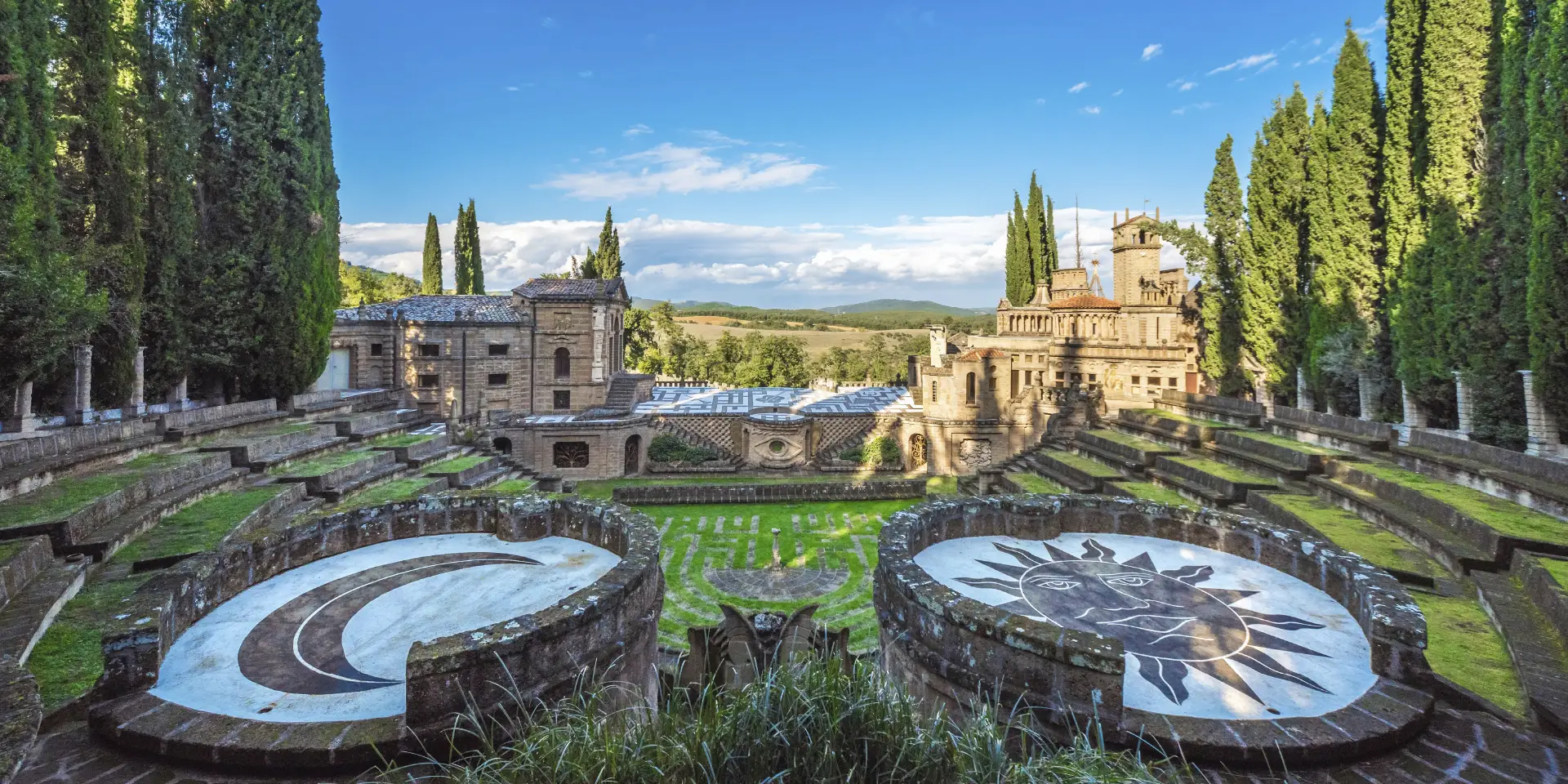
La Scarzuola: the stone dream in the heart of Umbria
The road narrows between woods and hills, the phone loses signal, and the noise of the world begins to slow down. When the austere walls of the convent appear, it feels as if you are entering another story, a fold of time where the real and the imagined hold hands. La Scarzuola is unlike any other place. It watches you in silence and asks you to move slowly, like in a theater just before the curtain rises. There, where tradition says Saint Francis built a hut of marsh reeds, a convent was born. Centuries later, a visionary architect, Tomaso Buzzi, arrived and decided to transform that silence into an ideal city made of symbols, staircases, theaters, and perspectives that chase each other. La Scarzuola today is this, a story written in stone that is read with the eyes and understood with the body, by walking.
The entrance feels like a held breath. The stone is warm with light, courtyards open like open-air rooms, and the convent, sober and solemn, withstands the first gaze. The Franciscan touch is clear in its measured order, in its speaking emptiness, in that spirituality that needs no adornment. It is the prelude, the quiet tone before the symphony. Then, little by little, the path bends and thickens, and the walls begin to suggest something else: masks, arches, stairs, niches, and echoes. La Scarzuola reveals itself and shifts tone, from monastery to dream.
There are places where the landscape sets the rules; here it is the staging that guides you. Tomaso Buzzi built a theatrical city, an erudite and playful labyrinth where the ancient and the modern call and answer each other. As you walk, you recognize fragments of memory: a staircase that feels like an ascent, a small temple evoking the Acropolis, an amphitheater whispering of performances, an arch opening onto a natural backdrop. It is not imitation or parody; it is an act of loving citation, flashes of classical memory carried here like seashells from a distant beach. Every element has weight, measure, and an ironic bow to the history of architecture, but above all, each serves a narrative function. At La Scarzuola you do not look at monuments; you walk through scenes.
The ground rises, falls, and curves, and the ideal city forces you to change your pace. At certain points perspective suddenly shifts, and proportions play tricks on your eyes like a magician shuffling cards. You approach a facade and find it tiny; you glimpse a dome far away, then it appears within reach. The staircases become bridges, the bridges become invitations, the corridors narrow before opening into terraces. It is a theater-labyrinth where the only thread, if there is one, is your curiosity. There is no haste, no arrows, only steps that choose their own direction.
Nature is not outside; it enters the story. The holm oaks draw lace-like shadows on the stone, moss softens the edges, lizards cross the scene like extras, and the air carries the scent of herbs and wet stone. On sunny days the color is honey; with clouds La Scarzuola turns to graphite, a city drawn in strokes, more severe, more mystical. When it rains, ancient voices rise from the cracks in the walls. Even silence here has different qualities. The silence of the convent is vertical, rising upward; the silence of the ideal city is horizontal, spreading and embracing.
The story unfolds on two tracks. The first is the Franciscan one, the simple gesture of a saint who chose a hut and made of little the measure of everything: a spring, a hermitage, a prayer shaped through daily work. The second is Buzzi’s, an elegant and ironic architect who, in the postwar years, chose this corner of Umbria to cultivate a dream. Not a stylistic exercise, but a declaration: architecture can be narrative, allegory, a serious game. La Scarzuola is a family lexicon of symbols: staircases that allude to inner journeys, theaters that ask to be inhabited, facades that become stages, windows that become eyes. No manual is needed; you only have to let your body understand.
There are corners made for pausing. An amphitheater facing a hill, a parapet where the valley opens like a fan, a staircase that climbs slowly and asks a different question at every step. Your hand glides over the stone, your eyes play with symmetry, your ear catches the rustle of the forest like background music. At times, without meaning to, you find yourself slowing down, counting your steps, imagining who before you might have walked in the same place. The ideal city works this way; it does not rush toward you, it waits.
The visit feels less like a lesson and more like a story. Words come, sometimes from the guide, sometimes from the stones, but most often it is the space that speaks. The tension between sacred and profane, order and play, convent and open work keeps everything alive. There is no provocation here, only a desire for dialogue. Buzzi does not shout; he smiles, invites, hides, and reveals. He pushes you to search and then to find yourself.
In a place like this, it is easy to think of travel as an inner gesture. La Scarzuola offers no squares where you sit and watch people pass; it offers perspectives where you sit and watch yourself pass, even if only for a moment. The staircases, so many staircases, become measures of breath: you climb, stop, look back, and look ahead. On clear days the line of hills seems like a painted backdrop; on hazy days it is as if a veil had been drawn across the scene.
There is a moment when you realize the path has stopped being a tourist route and has become a personal one. It happens when a detail catches you: a niche with a figure, a blind window framing emptiness, a chipped step that tells more than any description. That is when La Scarzuola stops being a famous place and becomes your own. Not because you stay there forever, but because something of its language settles inside you and begins to work slowly, like certain books read at the right moment.
At the exit, the convent greets you again with the quiet certainty of something that does not need to remind you of its importance. It is the axis around which everything turns, the compass that brings you back to earth after enchantment. The bare Franciscan beauty restores proportion to the forest, the hills, and the sky. And in that passage, from ideal city to cloister, from imagination to order, you understand the most delicate gesture of this place: not to oppose but to unite. Not to choose between prayer and imagination, between discipline and play, between memory and invention, but to accept that life is a continuous movement back and forth between polarities that need each other.
La Scarzuola does not live on noise or events. It lives through visits, steps, gazes, and stories that intertwine. Sometimes the guide turns an explanation into a small performance, a phrase sparks laughter, a gesture reveals a shadow. It is a theater that works without a show, because the actors are the spaces themselves, and the visitor, in turn, becomes part of the stage. As you leave, you feel as if you have witnessed a performance where words were few and architecture was the music.
A scent lingers on your skin, the warmth of sunlit stone and the forest just beyond the wall. Images remain too, a staircase, an arch, a window, returning at night like frames from a film you wish to see again. And above all remains a gentle question: what do you take away from here? Some answer silence, some say surprise, some speak of harmony, some of dreams. The truth is that La Scarzuola does not ask for one answer. It asks for openness, the patience to look, and the humility to not understand everything and to return, perhaps another time, in another light.
The road back reopens the world. The phone reconnects, traffic resumes, and words multiply. Yet there is a moment, between one curve and the next, when you realize the ideal city has not stayed behind the gate. It has slipped a piece of itself into your pocket and moves it just enough to make you long for a bit more harmony, a bit more irony, a bit more grace in things. Perhaps this is the subtlest gift of La Scarzuola: to remind us that building houses, cities, lives can be a poetic act. That it is possible to make space for mystery without losing proportion. That form is a promise, and keeping it depends on us.
There is no single perfect photo to summarize La Scarzuola. There are passages, corners, and glimpses that for some are essential and for others barely hints. There is the first gaze, and then there is the one when you return. And each time you realize that something has changed, not in the stones, but in the way the stones look at you. This is the silent greatness of the place, the ability to remain the same while generating new meanings. A living work, because living is the gaze that crosses it.
When finally the forest closes behind you and the name La Scarzuola remains only on a sign fading in the mirror, it is natural to feel a small sense of loss. Perhaps it comes from the end of a well-told story, or from the longing for a fragile balance that, outside in daily life, is harder to find. But there is comfort in this thought: the places that matter do not end when you leave them. They remain in a corner of your memory and return, quietly, when you need them. La Scarzuola stays like that, an open-eyed dream, a manual of wonder, a secular prayer carved in stone. And Umbria, all around, continues to protect that dream like a hand that holds without grasping.


