

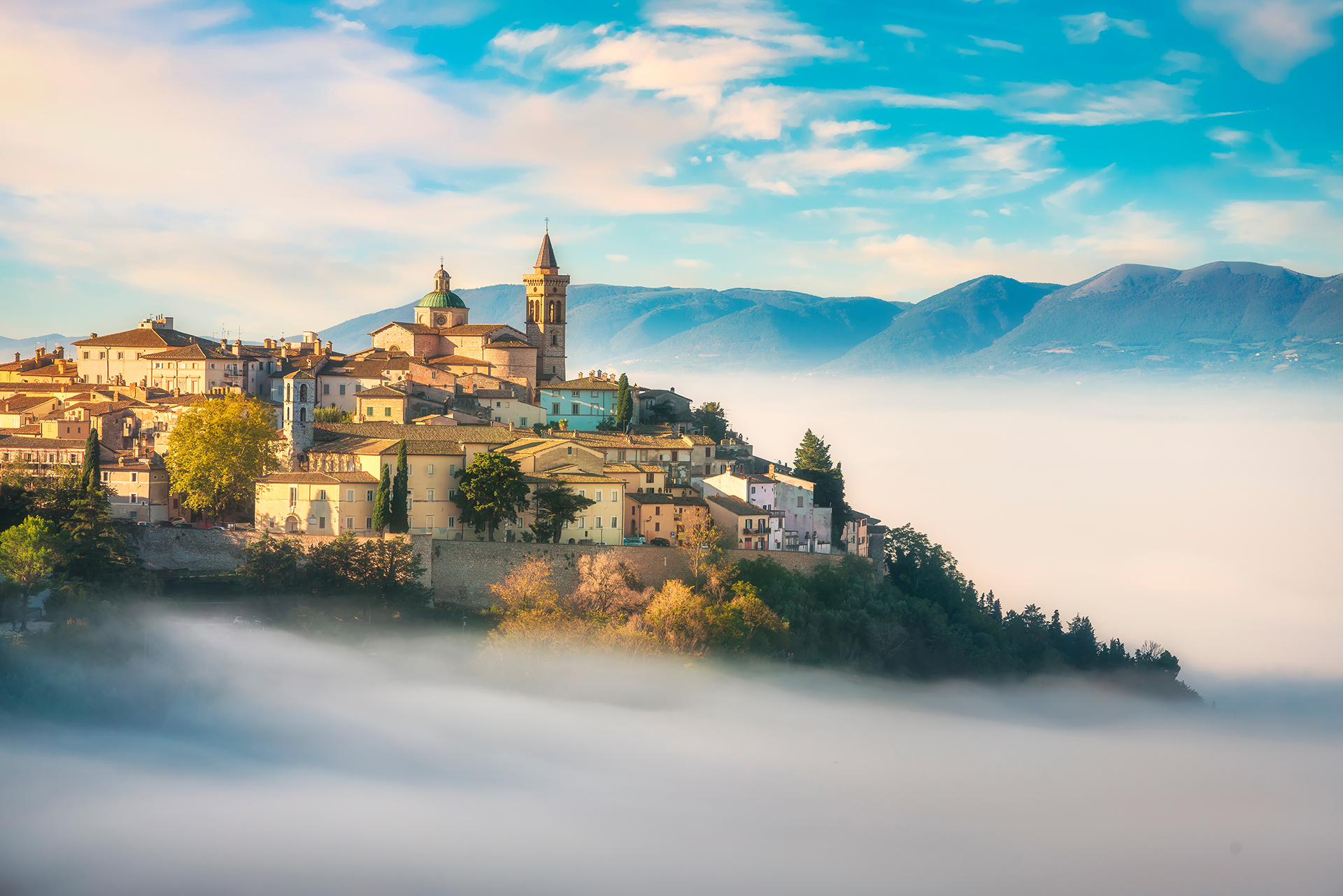
Trevi: the olive oil town between history and breathtaking views
Trevi appears from afar like a miracle of stone. Its clustered shape, a bunch of houses clinging to one another, seems to defy time as it climbs the hillside overlooking the Umbra Valley. Seen from the plain, it looks like a crown of towers and red roofs set in a silver sea, the olive trees, millions of them, that have surrounded Trevi for centuries and still shape the landscape today like an endless embroidery. It is a village that does not reveal itself immediately, one that must be conquered step by step, climbing the road that winds through the hills.
Entering through one of its medieval gates, you are immediately enveloped by a unique atmosphere. The stones of the houses bear the color of time, the alleys are narrow and winding, the stairs rise and fall as if following the very breath of the village. As you walk, the sound of your footsteps echoes, and you sense the quiet of a place that has chosen slowness as its way of life. There is no rush, no glittering shop windows, only the essential beauty of a village that has preserved its authenticity.
The heart of Trevi is Piazza Mazzini, elegant and intimate, a terrace suspended over the world. From here the gaze stretches far, embracing the entire valley. To the east you glimpse the course of the Clitunno River, to the south the profile of Spoleto, and to the north the rolling hills that lead to Foligno and Montefalco. It is a panorama that changes with the hours and the seasons, soft and velvety in the morning, bright and clear at noon, golden and emotional at sunset. Simply staying here, leaning against a wall or sitting on a bench, already feels like a journey, because your eyes fill with beauty and your soul finds peace.
The churches of Trevi tell the story of its long history of faith and art. The Church of Sant’Emiliano, patron of the town, preserves the memory of the martyr and fascinates with its sober and elegant Romanesque architecture. Inside, the dim light and the scent of damp stone invite silence and contemplation. Not far away, the Church of San Francesco, now home to the Museum of Olive Civilization, unites art and territory in a unique way. Here you do not only admire sacred works, but you also understand the ancient bond that ties Trevi to its green gold.
Olive oil is indeed the soul of Trevi, its deepest identity. The olive trees surrounding the town are not just crops but living monuments. Some are centuries old, others perhaps millennia, and looking at them feels like reading a book written in branches and roots. The extra virgin olive oil produced here is among the finest in Italy, intense and fruity, with a slightly peppery aftertaste that tells the story of this land’s character. In autumn, when the harvest begins, the hills become a great open-air theater. Whole families descend among the olive trees, spreading nets and gathering olives, while the air in the mills fills with the fresh, grassy scent of new oil.
It is an ancient ritual that culminates in the Festival of New Oil, when Trevi celebrates its greatest treasure. During those days, the town comes alive. The squares host markets, the oil mills open their doors to visitors, and the taverns serve warm bruschetta drizzled with freshly pressed oil. Every street becomes a hymn to the land, a chance to share a heritage that is not only gastronomic but also cultural and spiritual.
Alongside olive oil, Trevi also guards another treasure, the Black Celery, a unique variety that grows only here in the fertile soils of the valley. It exists nowhere else and has become a true symbol of the village’s gastronomy. Its long, fleshy stalks have an intense, fresh, and slightly sweet flavor that makes it unlike any other celery. In autumn, together with the new oil, it becomes the star of the Black Celery and Sausage Festival, an event that attracts travelers and food lovers from all over Italy.
Walking through Trevi during those days means immersing yourself in an explosion of scents and flavors. The alleys fill with food stalls, kitchens serve traditional dishes, and everywhere people celebrate this special vegetable. The most iconic dish is the Trevi-style Stuffed Celery, stalks of celery blanched and filled with a mixture of meat, eggs, cheese, and spices, then baked with a light tomato sauce. It is a dish that speaks of conviviality and memory, served for generations in family homes and still today at the center of local feasts. Tasting it in Trevi means savoring an authentic piece of its identity.
Trevi is a village that lives beyond its walls. Walking down the paths, you find yourself among olive trees and, further below, along the Clitunno River. Here the famous Clitunno Springs offer a natural spectacle that has enchanted poets and travelers since ancient times. Small pools of crystal-clear water, surrounded by poplars and willows, reflect the sky and create a magical atmosphere. It is no coincidence that for centuries they have been celebrated as places of beauty and inspiration. Those who come here immediately understand that there is something deeply poetic in this corner of nature.
The cuisine of Trevi reflects the character of its people, simple yet refined, humble yet full of depth. Every dish tells a story, from thick legume soups to grilled meats and wood-fired bread that becomes poetry when paired with new oil. And of course, the black celery, used in countless ways, in salads, soups, and fillings. Every table in Trevi is a weave of flavors and stories, an invitation to share.
There are moments that stay imprinted in your mind. Early in the morning, when the sun rises and paints the stones of the village in soft pink light. At noon, when life flows slowly through the narrow streets and the scent of cooking drifts from the houses. In the evening, when the lamplights glow and Trevi settles into silence, its walls shining like ancient gold. These are moments that speak directly to the soul and make you understand why Trevi is considered one of the most beautiful and authentic villages in Umbria.
When you leave Trevi and look back, you still see the village clinging to the hill, proud and discreet, and you realize that you have not just visited a place. You have encountered a way of life, a deep bond between land, community, and tradition. Trevi stays with you like the sharp taste of new oil, like the freshness of just-harvested black celery, like the voice of its eternal stones. It is a memory that does not fade, an invitation to return.


