

Narni: history, mystery, and nature in the heart of Umbria
You see it appear when the valley narrows and the river finds its voice. Narni is a fortress on a balcony of rock, a ball of stone looking over the Gorges of the Nera like a captain at the bow. Climbing curve after curve you feel Umbria change its pace. The hills grow brusque, the woods thicker, the air deeper. The first view is one that stays, a crown of red roofs, a tower piercing the sky, the Albornoz Fortress watching from above like a steadfast guardian. Entering the walls is like slipping into a pocket of time. The light gathers, alleys grow thin, the sound of the river fades, and voices come closer.
In Piazza dei Priori the stone has a warm color like ancient honey. Windows face the square like patient eyes, the town hall looks like an open hand. From here everything is within a few steps, the Cathedral of Saint Juvenal with half light that smells of wax and incense, arches chasing each other, flowered window sills, stairways that drop without warning toward a secret passage. The city is best read by walking slowly and letting your feet do their part. It is a simple grammar, step, turn, arch, breath. Now and then the scent of bread draws you toward a door left ajar, now and then a bell toll sets the air in order.
Narni has a double life. One is made of squares, churches, and towers. The other runs just below and is made of tunnels, cisterns, and walls that have stored centuries of damp and stories. The first time you take the way down to Underground Narni it feels like changing state. The air grows cooler, your voice echoes differently, the light narrows. Beneath the fabric of the town opens a parallel city, a small frescoed church rising from the dark like a pale flower, rooms that saw inquisitors and penitents, wells and cisterns still carrying the metallic scent of water. The subtlest passage is where the Roman aqueduct of Formina pushed its stubbornness into the rock, a narrow corridor that tells of ingenuity with a few centimeters of stone and silence. Emerging again is like surfacing from a dive. The city above seems clearer and lighter, as if you now knew its spine.
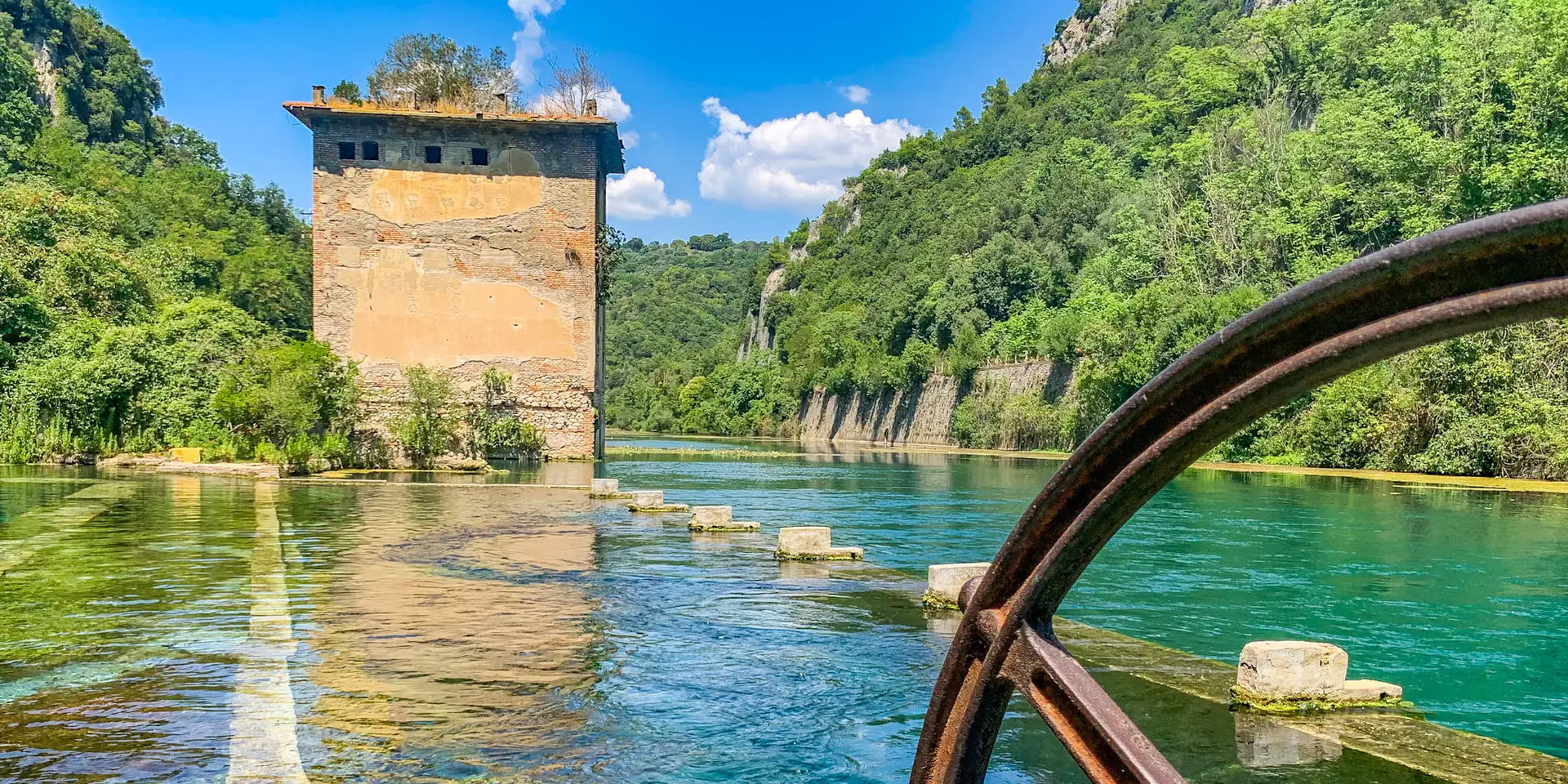
The river deep in the gorge sets the day’s rhythm. You reach it by descending toward Narni Scalo, where the cycle path of the Gorges of the Nera attaches itself to an old railway and turns it into a ribbon of shade and light. Tunnels stretch cool and the railings look out on glass like water. There are hours when the Nera is a dark table where the sun draws silver knives. There are others when it looks like a sheet of jade, still and deep. Continue and the turbid beauty of Stifone will surprise you, with its tiny harbor and the greenest water you can imagine. Time here is not a line. It is an eddy. When you sit on a bench with your back against warm wood, the far roar of a fall, the whisper of leaves, and a single stroke of an oar become a background song. Returning up to the town feels like going back home at the right hour.
On the cliff the fortress keeps watch, bright and clear. Climbing to the top lets you measure the city with a wider compass. Roofs turn to tiles, bell towers to pins, the gorge to a dark sweep of paint. The wind cuts clean. It carries the scent of dry grass in summer and of wet earth after the storms of September. From the arrowslits the light enters like a blade. You sit on the low wall and understand that this high point is more than a view. It is a proportion. Narni is not only defense. It is gaze.
There is a stone in the woods not far from town that many seek like a discreet talisman. It marks the geographic center of Italy, a modest sign set in the green near Ponte Cardona. It is not a dramatic scene and no fanfare is needed. It is the measured pleasure of a center that does not require clamor. Reaching it on foot among oaks and holm oaks is a way to take your time and to feel beyond the walls the breath of this land that tightens and widens like a lung.
Each spring Narni keeps an appointment with itself. When the calendar shifts between April and May the streets fill with velvet and silk, drums set an ancient rhythm in their chests, and costumed figures walk with long steps, heads high, eyes bright. This is the Corsa all’Anello, a simple name for a complex rite. The city splits into three districts, finds itself in taverns, and prepares flags and horses. On race day the track turns to lightning, riders surge forward to catch an ever smaller ring, and the neighborhoods hold their breath. Yet the whole festival takes the center, the processions, the crossbow contests, the aromas of kitchens that revive old recipes, words in the square that warm into a chorus. In those weeks Narni does not perform. It remembers. And even if you have come from far away you end up choosing a color, a side, a lane where you stop for a glass of wine.
The ancient town speaks to Rome like a younger sister. You feel it in front of the powerful ruins of the Bridge of Augustus, a shoulder of stone left standing like a muscle, an arch no longer there but traced in space. The force of those blocks is striking. They feel like shards of mountain tamed. If you go close with care you see in the cut stone the patience of work and the trace of a hand that chiseled and hammered. It is a huge fragment of a greatness that does not beg for wonder. It simply deserves it. Together with the tunnels of the aqueduct it tells that water and road here were planned with perseverance.
Within the walls daily life moves with polite slowness. Early morning the square wakes with small cups and warm bread. Shutters open softly, a broom makes the stones sing, an elderly woman lays two cloths in the sun. At noon the sun takes the middle of the street and nudges people into the shade of porticoes. Someone reads on the low step of a church, someone goes down to the Loggia dei Priori to seek a breath of air. In the afternoon visitors thin out and the town stays in the hands of its own people, voices that recognize one another from afar, names spoken halfway, nods for greetings. Evening brings soft lights, the stone takes the color of well baked bread, the valley darkens, and the river raises its voice.
At the table Narni is honest and generous. On bruschetta the oil has that green which tells of the hills at once. The torta al testo comes with its warm crust. Ciriole alla ternana have the roughness that holds sauce well. In winter a soup of legumes warms you to the shoulders. If you find palombaccio cooked in the old way you will see how the kitchen here treats its ingredients with respect. When a slice of pecorino arrives with dark honey you sense that simplicity, when exact, is already beauty. In the glass there is often a red that smells of cherry and spice, a local Ciliegiolo with the frankness of one who does not dress up.
Not everything is polished in a town like this. Some walls still carry old irons, doors marked by damp, crooked stairs that ask your feet to pay attention. These rough edges give depth to the weave. Narni is not a computer drawing. It is a hand woven fabric. As you walk you learn to recognize the sounds that return, a gate that squeaks always in the same way, a small bell that marks noon with a distinctive tone, the laugh of a child that rings in a courtyard like a coin dropped on stone.
When you take the road that leads to the fortress there is a moment when the town settles behind you like a cloak and the elegant void of the gorges opens ahead. If it is sunset the line of trees turns to ink and the river to a strip of tin. If it is morning swallows sketch geometry above the bastions and the low light makes moss on the stones shine. Standing a few minutes with your elbows on the battlements is a way to learn patience. Meanwhile the town below continues its life at the right height.
There are days when Narni tells itself with small scenes, a workshop where a carpenter works with the door open and greets you with a nod, a woman who points out a shortcut that is not on your map, a child who tosses a ball and asks for it back with a serious gesture as if it were a mission. In those moments you understand that travel is not only the sum of monuments. It is the sum of gestures. Later your memory will not be the perfect photo of the view but that unhurried thank you, that stair polished by steps, that scent of air before rain.
Going down toward the Nera in autumn is an exercise in colors. The forest brings out all its burns, rust, copper, wine. The cycle path is gentle and invites a pace between stroll and thought. If you carry a sandwich and open it on a bench in the shade the valley answers with a rare kind of silence, not an absence but the right measure. In spring the water is broader and the birds louder and flowered meadows break the monotony in white and yellow patches. In summer the shade of tunnels is a relief. In winter the breath of water rises like smoke.
Narni is a place to cross more than once. The first time for the general design, the second for details you missed, the third for the pure pleasure of finding what you now know. By day it is severe and bright, by night intimate and golden. It does not need to shout. It has the authority of a place that holds together forest and stone, river and wall, rite and everyday life. When at last you take the road that descends, a final glance toward the fortress comes naturally. Up there at the border between city and sky is the point where all the chapters you have just lived meet.
What you take with you is not a postcard. It is a weave. The quiet roar of the Nera, the half light of the underground that smells of ancient water, the sound of drums in spring, a warm slice of bread soaking up new oil, a sudden laugh in an alley, a high wind on the fortress that clears the mind. It is enough to see why Narni cannot be done in an hour. Narni is a place to frequent. You learn it as you learn a language, returning to the words until they become your own. When you set out again with the river to your right and the valley opening you already know that one day you will return to check that everything is still in its place, the stone, the water, the right silence between one bell and the next.


